UN-backed Cambodia genocide tribunal begins fitness hearing for accused
August 29, 2011
ARAKANLAND

29 August 2011 – The United Nations-backed tribunal in Cambodia dealing with mass killings and other crimes committed under the Khmer Rouge three decades ago began its fitness hearing today into the health of two of the ageing defendants currently on trial.
Nuon Chea, 84, and Ieng Thirith, 79, are among four most senior surviving leaders of the Khmer Rouge facing charges before the Extraordinary Chambers in the Courts of Cambodia (ECCC), sitting in Phnom Penh.
They are accused of genocide, murder, torture, religious persecution and other war crimes and crimes against humanity over their alleged actions when the Khmer Rouge was in power between April 1975 and January 1979.
Professor John Campbell, a specialist geriatrician from New Zealand, was in court today at the start of the three-day hearing aimed at determining whether the accused will be well enough to stand trial.
In his assessment, Mr. Campbell found Ieng Thirith, a former social affairs minister under the Khmer Rouge, “cognitively impaired” which compromised her rights to a fair trial. He also explained that Nuon Chea was unable to sit for long periods, but that he was otherwise fit to stand trial and did not suffer from cognitive or memory problems.
Mr. Nuon, known as “Brother Number Two” under the Khmer Rouge, acted as chief policy architect of the Communist Party of Kampuchea, controlled the country’s internal security apparatus and rendered support for the regime’s policies of forcible relocation, enslavement and other inhumane acts.
They are on trial along with Ieng Thirith’s husband, Ieng Sary, an 84-year-old former history professor who served as foreign minister and deputy prime minister under the Khmer Rouge, and Khieu Samphan, 79, who served as head of State of Democratic Kampuchea. He took over from Pol Pot when he retired as the official head of the Khmer Rouge in 1987.
Under their alleged leadership, at least 1.7 million people are believed to have died for torture, starvation and execution, the ECCC said in a news release.
The Trial Chamber held an initial hearing of the trial in late June and is expected to begin substantial hearing to examine evidence and witnesses by early next year.
More than 800 people came to the Court to observe the fitness hearings today, many of them high school and college students.
The ECCC was set up in 2006 and the UN provides assistance through the UN Assistance to the Khmer Rouge Trials (UNAKRT) and participates in the operations of the tribunal.
Source; UN News Service
Posted at: 04:10 PM | 0 Comments | Add Comment | Permalink
 |
|  |
|  del.icio.us
Myanmar needs to do more to improve human rights situation, says UN expert
August 29, 2011
ARAKANLAND

25 August 2011 – While the new Government of Myanmar has taken steps to improve the human rights situation in the country, it needs to deploy greater efforts to address serious concerns such as the continuing detention of a large number of political prisoners, a United Nations expert said today.
Earlier this year Myanmar’s newly-convened Parliament elected a new President and two vice-presidents, a move welcomed by Secretary-General Ban Ki-moon, who had stated at the time that he hoped it would lead to the formation of a more inclusive civilian government that is broadly representative of all parties and more responsive to the aspirations of the people.
“This is a key moment in Myanmar’s history and there are real opportunities for positive and meaningful developments to improve the human rights situation and bring about a genuine transition to democracy,” Tomás Ojea Quintana said at the end of his five-day mission to the South-East Asian nation.
“The new Government has taken a number of steps towards these ends. Yet, many serious human rights issues remain and they need to be addressed,” added Mr. Quintana, who has served since 2008 as the UN Special Rapporteur on the situation of human rights in Myanmar.
“Of key concern to me and to the international community is the continuing detention of a large number of prisoners of conscience,” he stated in a news release issued in Yangon.
The expert said that in his meetings with the Government, he conveyed his belief that their release is a “central and necessary” step towards national reconciliation and would bring more benefit to Myanmar’s efforts towards democracy.
Last December, Mr. Quintana had urged the Government to release at least 2,202 prisoners of conscience still detained one month after the freeing of pro-democracy leader and Nobel laureate Aung San Suu Kyi, saying many of the prisoners are seriously ill as a result of harsh jail conditions.
He had the opportunity to meet with Ms. Suu Kyi during his just completed visit, as well as with other Government ministers and other relevant stakeholders. In addition, he saw the new Parliament in session in Naypyitaw and visited Insein Prison, where he met with prisoners of conscience.
In his end-of-mission statement, the Special Rapporteur voiced concern about the continuing allegations of torture and ill-treatment during interrogation, the use of prisoners as porters for the military, and the transfers of prisoners to prisons in remote areas where they are unable to receive family visits or packages of essential medicine and supplemental food.
Other concerns highlighted include tensions in ethnic border areas and armed conflict with some armed ethnic groups, which engender serious human rights violations, including attacks against civilian populations, extrajudicial killings, sexual violence, arbitrary arrest and detention, internal displacement, land confiscations, the recruitment of child soldiers, as well as forced labour and portering.
“I call on the authorities and all armed groups to ensure the protection of civilians in conflict-affected areas and to accelerate efforts towards finding a political solution to the conflict,” he stated.
Among his recommendations, Mr. Quintana encouraged the Government to take the necessary measures for investigations of human rights violations to be conducted in an independent, impartial and credible manner.
“Justice and accountability measures, as well as measures to ensure access to the truth, are fundamental for Myanmar to face its past and current human rights challenges, and to move forward towards national reconciliation,” he stated.
UN independent experts, including Mr. Quintana, report to the Geneva-based UN Human Rights Council. They work in an independent and unpaid capacity.
Source: UN News Service
Posted at: 04:06 PM | 0 Comments | Add Comment | Permalink
| | del.icio.us
The Burman ethnic group needs to change their minds
August 23, 2011
ARAKANLAND
The Burman ethnic group needs to change their minds for peace and stability in future of the Union of Burma
By Khaing M. Thein
The Union of Burma is containing different ethnicity, so there are different cultural, different literatures and different values, but Burman ethnic is still not recognize them. They are only Burmanization and coercion policy toward other ethnicity. It was since 1948; therefore many non-Burman ethnics believe that the ethnic Burman is violator of natural rights and broken of moral obligation in Burma. Burman ethnic has been stated that 60% population is the ethnic Burman, but it is not sure at all; for instance, the ethnic Burman-Chin married and they born child is going to be listed ethnic Burman and also ethnic Karen-Mon married and they born child is possible going to list Burman ethnic etc. because Burma census is infallibility.
What is political interests in the Union of Burma, if you are adopted democratic principles in Burma you should understand democratic norms and values, so our political interests are protecting and prosperity of its citizen and as well as others. But, Burman ruler is never ignored it. Everyone should respect universal values at home and around the world, but ethnic Burman ruler has been failed since 1948. After independence Burman ethnic has been belligerency to other ethnicities to control country everlasting without regarding other people rights as well as most exile ethnic Burman politicians are the same ideas. Burman people are not being devoted well on placidity in country. They are predominated compulsion philosophy among them. The ethnic Burman is eschewing to express as one ethnic group from Burma because perhaps most ethnic Burman are misunderstanding between in terms of “ethnic and nationality.” Therefore, all Burman publications, news, and radio have not been expressed as one ethnic in the Union of Burma, so it is historically prevaricating by Burman ethnic group. Also, soft power is one of very important in democratization, but many ethnic Burman radio station is committing dissemble, and make use of tool of power for Burman ethnocentrism. For example, one of outside radio stations, the BBC Burmese service is more following Burmanism ideas because everyone can see on their website that “Thi Yin Thar Yeyar and Myanmar Yeyar,” so it is vexing and disparaging to the all ethnicity in Burma, also it is assuming that apocalyptic ideas and unbalance among the all ethnic groups in Burma. It is so bad propaganda from BBC Burmese service.
The Arakan and Mon are descended very earlier than the ethnic Burman in today so called the Union of Burma. However, the ethnic Burman is shameless doing that “the ethnic Burman is only superior ethnic in Burma.” As human being it is deeply shocking such Burman ethnic conduct toward other ethnicity. The Burman ethnic history started AD 1044 and the ethnic Arakan history recorded BC 3325, so it is huge distinction between the ethnic Burman and Arakanese. It is look like ethnic Burman is grandson level by Arakan people. Therefore, Burman ethnic needs to effort in truth to be accept by other ethnic groups. This is an inappropriate issue by Burman ethnic and also very against universal values. This is not partial and against ethnic Burman and also there is looking to express good conducts about ethnic Burman, but there is not found anything about ethnic Burman moral obligation in the Union of Burma history.
There is no idea that how ethnic Burman is going to define about in term of “ethnic” probably they think that “in term of ethnic” mean lower stage than “nationality.” So, the most Burman educated people know that, but no one wants to fix to be justice and equality among different ethnicity. Original ethnic is more powerful in term of political matter than nationality. For example, if someone is immigrating to some country and this person can have nationality in that country, but a person is not going to get opportunity as state’s president because a person is not natural born in there. So, that means nationality can be any person in Burma, but cannot be original ethnic. So, there is considered that the ethnic Burman is one of original ethnic group in the Union of Burma. Also, all people are born and there have to the same rights in Burma. In addition, the ethnic Burman is calling more democratic value in Burma, but they not follow what a democratic value is because many other people seem that Burman ethnic is still grasping ethnocentrism inside and outside of Burma. So, other ethnic non-Burman nationalities are more bitterness about Burman ethnic conducts and also seriously hard to trust them because they are historically nefarious at any level stage and by the ethnic Burman.
The ethnic Burman is not yet lesson or regret today’s world, so there is just let them to know that today world is real world and the ethnic Burman needs to avoid cheating at all, and they need to bring to an end about hostile and compulsion toward other ethnicity in Burma. The country is very poor level because it has been filthy ruling by the ethnic Burman. The ethnic Burman not yet views today’s world political system. There is never experience like U Thein Sein ruling system in political cultural, because U Thein Sein democracy power is flowing from the ethnic Burman group, even though there is a lot of ethnicity and they have broken constitution and all other parties are just powerless in Senate or Thein Sein ruling political system. It is not the way political system in Burma and it is till antagonistic toward other ethnicity because most military leaders are very lack of understanding political science or universal value in democratic principles. For example, The Kachin Independence Army (KIA) officials, led by second-in-command Gen Gun Maw, met with the Burmese military delegations led by Col. Than Aung, minister for border affairs in Kachin State. According to their meeting video type, Col. Than Aung was not treat KIO like as ethnic conflict issue and only emphasized on surrender policy. Col. Than Aung addressed that “if bad child is being run from home, but when he right viewed and returned to home, parents have to accept him.” It was very insulting all ethnicity of non-Burman and KIO, because we are fighting equality and justice for all people in the Union of Burma. Many such like people are bestowing political power in Thein Sein’s democracy system. It is very bad for different ethnicity reconciliation issue and his skills is only focus on ethnocentrism policy and it’s so ridiculous level. If Burman ethnic group is not going to change their minds and conducts in this era in so called the Union of Burma continue trouble, it is so depending Burman ethnic group.
Date: 8/22/2001
Posted at: 11:25 AM | 0 Comments | Add Comment | Permalink
| | del.icio.us
6th Annual Conference of WAO-USA in IOWA
August 17, 2011
ARAKANLAND

WAO-USA- 6TH Annual Meeting of World Arakanese Organization (WAO)- USA Branch successfully held at the place of Embassy Suites Hotel in Des Moines, Iowa sponsored by Arakanese family (Iowa) on August 14, 2011.
Over 100 attendees were participating and U Tun Won, U Saw Shwe (Iowa) and U Saw Shwe (Kansas) were elected as Presidents of Conference according to the reports said. All participants in conference came from California, Nevada, North Carolina, Kansas, Illinois and Iowa.
During the meeting, U Tun Won, patron of WAO, U U Sein Tun, President of WAO-USA and Vice President of WAO delivered opening speeches and Dr. Aye Chan, President of WAO also spoke his greeting speech by phone. Both leaders U Tun Won and Dr. Aye Chan emphatically urged to weld together all Arakanese as United We Stand. Especially, Dr. Aye Chan explained what's meant and definite social matter is broad and WAO's objective is only social. U Tun Won also encouraged the attendees to assist between each other among the Arakanese who can do it efficiently.
Power point presentation was presented by Ko Kyaw Htoo Aung explained about WAO and its relief efforts of assistance to Arakanese flood victims and Giri cyclone natural disasters who suffered from Mrepone, Pouk Taw and Kyauk Pru Townships in 2010. He also added of explanation WAO has committed itself to support Arakanese students and awarded an educational prize for winners yearly.
WAO-USA's 6th Annual Conference was open 1pm and closed 5pm after discussing all the social questions including Q&A accordance with meeting agenda that announced by Zaw Myo Naing who took as master of ceremony.
Please link to clip more photos:
https://picasaweb.google.com/102651077499186819957/6thAnnualWAOUSAConference#5641260567818816050
Source: WAO-USA
Posted at: 07:19 AM | 0 Comments | Add Comment | Permalink
| | del.icio.us
13 August Remembered
August 16, 2011
ARAKANLAND
Akyab,Arakan-13-8-11-Arakanese people in Akyab, a capital of Arakan, respectfully offered food for monks as a meritorious deed for demonstrators who were killed by U Ne Win, a Burmese infamous military leader of military council on August 13, 1967 in Akyab during the rice crisis day.
During the August, 1967, Arakanese people were facing in rice crisis as hunger due to shortage of rice and Ne Win government did not supply the rice and people's will. At that time, there was a lot of rice in stores in Akyab and government's purpose it was to sell out of country.Arakanese people peacefully demand with slogans "Arakanese do not eat boiled rice""Arakanese do not eat broken rice" to sell the rice in front of Mra rice mill and through the Kuntan road.
A troop of Burmese Army, under the Central Command, led by Brigadier Tin Oo(now vice president of NLD), was shooting to kill Arakanese people. Witness source said at least 300 demonstrators shot death by Burmese Army. Burmese Broadcasting Service announced there was at least 20 people were dead. During that time, Colonel Saw Fru, a traitor of Arakan, was appointed the Chairperson of 13 Division as Arakan and he was unable to protect Arakanese lives.
Posted at: 11:29 PM | 0 Comments | Add Comment | Permalink
| | del.icio.us
Ban exhorts academia to find solutions to global hunger, poverty and intolerance
August 11, 2011
ARAKANLAND

10 August 2011 – Secretary-General Ban Ki-moon today exhorted the world’s academic community to find solutions to global hunger and malnutrition, come up with ideas to promote sustainable and inclusive development, and advance tolerance through mutual respect and understanding.
“You are all aware that people across the Horn of Africa are starving. A catastrophic combination of conflict, high food prices and drought has left more than 11 million people in desperate need,” Mr. Ban told participants at the United Nations Academic Impact Forum in Seoul, Republic of Korea.
“Even as we respond to this immediate crisis, we need to deal with underlying causes. We need to focus on practical measures – drought-resistant seeds, irrigation, rural infrastructure, livestock programmes; improvements in early warning systems,” Mr. Ban told the forum, hosted by the Korean Council for University Education and Handong Global University.
The Academic Impact is a global initiative that aligns institutions of higher education with the UN to actively support universally accepted principles in human rights, literacy, sustainability and conflict resolution, among others. It was formally launched at UN Headquarters in November last year and 670 academic institutions in 104 countries have since joined the initiative, including 47 from the Republic of Korea.
Mr. Ban said there can be no peace, justice and dignity in the world if billions of people are forced to live in chronic poverty.
“We need to focus on the links among hunger, water and energy, so that solutions to one can become solutions to all. The academic community can help us connect the dots,” he said, urging scholars to take their ideas to the UN Conference on Sustainable Development (Rio+20) in Brazil in June next year.
On tolerance and peaceful coexistence, the Secretary-General stressed that the academic community, with its long-standing traditions of cultural exchange, can set an example of mutual respect and understanding.
“During a period when extremism and polarization show little sign of lessening, such a contribution would be timely indeed.
“So let us go forth together – students, teachers, university presidents, national governments and the United Nations – to affirm our common purpose and the partnerships that can do so much to build a better world for all,” Mr. Ban added.
He said he believed that institutions that had joined the Academic Impact had done so because they believed in intellectual social responsibility and they were seeking to work closely with the UN to make the world “wiser, safer and more just.”
The Secretary-General said the Academic Impact had spawned an offshoot known as “ASPIRE” – Action by Students to Promote Innovation and Reform through Education – and thanked the students for their engagement, including through raising funds for relief work after disasters in Haiti and Japan.
“The message is clear – there is no area of study that cannot make a difference to the United Nations and the people we serve,” said Mr. Ban.
He stressed the need for unfettered sharing and exchange of human thought to promote collective solutions to common problems, integrity of research and support for academic activity.
Mr. Ban met with representatives of Korean businesses that are members of the UN Global Compact, an initiative that seeks to foster socially responsible corporate practices. He thanked the business community for its work in support of the UN and encouraged them to be even more engaged in promoting social justice and sustainable development.
He also conferred with the Speaker of the National Assembly and members of the institution’s Working Group on the Millennium Development Goals (MDGs).
The Secretary-General also met the Venerable Jaseung, the President of the Jogye Order of Korean Buddhism and stressed the important role that religious leaders can play to help the UN promote peace, development and human rights.
The Venerable Jaseung informed Mr. Ban of his plans to travel to the headquarters of the UN Educational, Scientific and Cultural Organization (UNESCO) in Paris to discuss with Director-General, Irina Bokova, how the Jogye Order can contribute to the agency’s work. The Secretary-General welcomed the initiative.
At a meeting with President Lee Myung-bak and First Lady Kim Yoon-ok, the Secretary-General thanked the Government of the Republic of Korea for its contributions to the relief effort in the Horn of Africa. He pointed out that as a result of the country’s economic development and democratization, the international community was increasingly looking to Seoul’s capacity and experience to address global challenges.
Speaking at the Yonhap International Photo Awards on MDGs, Mr. Ban called for an accelerated effort to ensure that the global poverty eradication and social development targets are met by the 2015 deadline.
Source: UN News Service
Posted at: 11:26 AM | 0 Comments | Add Comment | Permalink
| | del.icio.us
Press Release by International Council for the Indigenous Peoples of CHT (ICIP-CHT) – “UN ECOSOC rejects Bangladesh Government’s challenge to UNPFII’s mandate to deal with CHT Accord”
August 7, 2011
ARAKANLAND
July 31,2011-
UN ECOSOC rejects Bangladesh Government’s challenge to UNPFII’s mandate to deal with CHT Accord
The General Segment of the United Nations Economic and Social Council (ECOSOC), whose session started on 22nd July, ended yesterday (29th) in Geneva, Switzerland. ECOSOC is the parent body of several subsidiary bodies, including the UN Permanent Forum on Indigenous Issues (UNPFII), and reports to the UN general Assembly.
After intense negotiations over the past three days and even up to the last minute of the agenda, the ECOSOC rejected the GoB’s requests and adopted the UNPFII report. Bangladesh had expressed its concerns over the PFII going beyond its mandate in dealing with the issue of the implementation of the CHT Accord of 1997, on the ground that there were no indigenous peoples in the Chittagong Hill Tracts (CHT). Statements in explanation of its position were made by the GOB, as by others among the fifty-four members of ECOSOC. However, the GoB lacking solidarity from other ECOSOC member-states, accepted to ‘compromise.’
A few of the many concerns raised by the GoB are to be included as ‘noted’; in the nature of a ‘footnote.’ However, ECOSOC, will not delete any paragraphs of the 10th session report, as was pleaded by the GoB. ECOSOC will not distinguish between indigenous and tribal groups, as highlighted by the GoB, or take into account the GoB’s challenge of the jurisdiction of the PFII to deal with the CHT Accord of 1977 on the basis that the ethnic groups of the CHT were not indigenous, and hence outside the purview of the mandate of the PFII.
The UNPFII, in June, had called on the GoB, to undertake a ‘phased withdrawal’ of temporary army camps from the CHT, declare a timeframe for implementation of the peace accord, and establish an independent commission to inquire into ‘human rights violations perpetrated against indigenous peoples’ as per the 1997 CHT Accord. UNPFII further recommended that the UN Department of Peacekeeping Operations (UNPKO) review the military personnel and units, who are being sent on UN missions to make sure no personnel or units are taken from any, that are accused by indigenous Jumma people of violating human rights in the CHT.
Other country responses:
The USA seemed determined to protect the integrity of the UNPFII and this reflected a major shift in its international engagements with regard to indigenous issues under President Obama.
Mexico was the lead facilitator and played a very constructive role in the consensual decision. Bolivia highlighted PFII as the only space for dialogue on IP issues in the UN; France (EU) reaffirmed independent nature of PFII and reiterated that the report be adopted by consensus, albeit with a note, refers to a specific situation and does not set a precedent for ECOSOC to deal with reports of a subsidiary body; Australia supported the role of the PFII as a constructive forum for dialogue; in such complex situations as in the CHT, it stands ready to assist GOB/ and people of the CHT in dialogue; and Morocco welcomed adoption by consensus.
Reportedly, only China, Pakistan and Saudi Arabia, all three countries with the worst human-rights records in Asia, provided some support to the concerns raised by Bangladesh; Even though Russia showed some leaning towards GoB’s stance, they reiterated the importance of the role of indigenous peoples on the international human rights agenda.
FINAL & FULL TEXT ADOPTED BY ECOSOC CAN BE FOUND AT: http://www.unog.ch/unog/website/news_media.nsf/%28httpNewsByYear_en%29/EE007477BCA3B90FC12578DC003B50EE?OpenDocument
Published by ICIP-CHT (International Council for the Indigenous Peoples of CHT)
Media contact:
Prof Mong Sanu: +88 01730086301
Wasfia Nazreen: +88 01675588890
Source: Jumma Peoples Network-UK
Posted at: 04:55 PM | 0 Comments | Add Comment | Permalink
| | del.icio.us
Three Indigenous slaughtered while trying to save girl from rape
August 1, 2011
ARAKANLAND
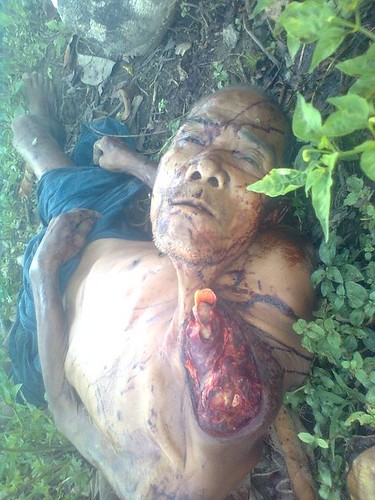
Photo of slaughtered Mr. Aung Sha U Marma (70 years)
On 30 July 2011 at around 12 pm, three indigenous Marma villagers were killed as they tried to save a young Marma girl from rape by some Bengali settlers at Siletuya Paea of Rupashi union under Lama upazila (sub-district) in Bandarban district.
The identified victims are (1) Mr. Aung Sha U Marma (70 years) s/o late Mong Chabai Marma, pictured above,

(2) Ms. Hla Powang Prue Marma (40 years) w/o Mongchasa Marma (pictured above) and (3) her minor son Mong Nue Ching Marma (5 years).
According to Rupashipara Union Parishad chairman Maching Marma, five Bengali settlers sneaked into a farm house in the village at noon and grabbed 15 year-old daughter of Ms. Hla Powang Prue Marma working in the farm house, and attempted to rape her.
As the girl cried out for help, Aung Sha U Marma and Hla Powang Prue Marma rushed to the spot. A minor boy, Mong Nue Ching Marma followed his mother.
The attackers slaughtered all three of them, as they tried to free the girl from rape. The raped girl has been admitted to Bandarban district hospital.
How long is this going to go on for? And how long are we going to stay silent?
All photos taken on cellphone by Subrata Saha Shuvro
Source: http://unheardvoice.net/blog/2011/07/31/indigenous-girl-rape-by-bengali/
Posted at: 11:19 AM | 0 Comments | Add Comment | Permalink
| | del.icio.us

