RNDP's Shwe Gas Movement
February 26, 2012
ARAKANLAND


RNDP's GS U U Hla Saw Speaks Out for Shwe Gas Movement


Posted at: 05:25 PM | 0 Comments | Add Comment | Permalink
 |
|  |
|  del.icio.us
Defy Shwe Deny Shwe
February 24, 2012
ARAKANLAND

Dear Leaders, colleague and friends,
Warm greeting from Shwe Gas Campaign!
As an important ally of the Shwe Gas Movement, we would like request that your organization endorse a joint-letter to President Thein Sein demanding that the Shwe Gas and Trans-Burma Pipelines Project be postponed. The jointly endorsed letter will be submitted to the President on 1st March 2012 as part of the Global Day of Action against the Shwe Project. Please let us know if your organization is willing to endorse the joint-letter. In addition to the letter, Shwe Gas Movement’s allies around the world will organize a range of solidarity actions in their respective locations. The solidarity actions for the 1st March Global Day of Action will include : Peaceful protests at local Burmese, Chinese, South Korean or Indian embassies demanding the Shwe Gas Project be postponed Delivery of letters to Burma’s President Thein Sein (through local Burmese embassies) demanding the Shwe Gas Project be postponed Media outreach to encourage wide-spread media coverage of the community concerns about the impacts Shwe Gas Project and the Global Day of Action
I have attached a sample letter to President Thein Sein. Additional advocacy materials can be downloaded at the Shwe Gas Movement website at
http://www.shwe.org/global-day-of-action/global-day-of-action-against-the-shwe-gas-and-china-burma-pipelines-project/
Photographs, cartoons and graphics are also available on the website. Looking forward to hearing from you soon. In solidarity, Shwe Gas Movement- www.shwe.
U Thein Sein
President of the Republic of the Union of Myanmar Nay Pyi Taw
Myanmar
1st March 2012 Dear President U Thein Sein, The undersigned are writing to express our concern about the Shwe Gas and Trans-Burma Pipelines Project led by Myanmar Oil and Gas Enterprise and the Chinese state-owned China National Petroleum Company. There are a number of serious social, economic and environmental impacts of this project, including human rights abuses. We are calling for the government to postpone this project until rights are protected and negative impacts are prevented within a sustainable framework for national development.
The project is exporting valuable natural resources and missing an opportunity to contribute to national development while at the same time causing destructive impacts to local communities and the environment, including ruining livelihoods and increasing militarization and abuses. Several civil society organizations including the Shwe Gas Movement have documented these impacts. Thousands of acres of farm lands have been confiscated in Arakan and Shan States and Magwe and Mandalay divisions to clear the way for the pipeline corridor and related infrastructure. The livelihoods of local fishing families in Arakan State have been destroyed due to development of offshore infrastructure for the project. Militarization has been heightened along the pipeline corridor, causing internal displacement and sparking new resentment against the Shwe Gas Project and other natural resource exploitation projects like it. We believe that Burma’s natural resources have the potential to spur the national economy without harming local communities. These projects should be based on a sustainable framework for development which includes meeting domestic energy needs instead of exporting valuable natural resources and protecting community rights to their lands and livelihoods through genuine consultation and free, prior and informed consent for projects that will directly affect their lives. In addition, any revenue from such projects must be used transparently for sustainable development of the country. Your government recently announced the suspension of both the Irrawaddy Myitsone Dam and the coal-fired power plant in Dawei due to the negative impacts of the projects and concerns from the people. Due to the harmful impacts of the Shwe Gas and Trans-Burma Pipelines Project, we call for a consistent policy of social and environmental accountability, and an immediate postponement of the project.
This project is risky business for all parties involved and has the potential to create and/or further inflame conflict in Burma. By acting now to postpone the Shwe Gas and Trans-Burma Pipelines Project and taking steps to deal with theproblems listed above, the government will greatly improve its reputation among the citizens of Burma and internationally .Sincerely,
Copy: Please link to Facebook "Defy Shwe Deny Shwe";
http://www.facebook.com/pages/Defy-Shwe-Deny-Shwe/313307475382348
http://www.facebook.com/#!/photo.php?fbid=10100103579827119&set=a.10100111553797219.2372884.12821604&type=1&theater
Posted at: 08:40 PM | 0 Comments | Add Comment | Permalink
| | del.icio.us
UN forum in South-East Asia calls for more investment to reduce disaster risks
February 22, 2012
ARAKANLAND
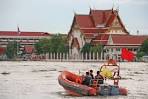
Flooding in Bangkok, Thailand
20 February 2012 – Last year's devastating floods across South-East Asia were a “wake-up call” on the need for much greater investment in disaster risk reduction across the region, a United Nations forum heard today.
Delegates from nine countries attending the one-day forum, held in Bangkok and co-organized by the UN Economic and Social Commission for Asia and the Pacific (ESCAP), called for much greater investment in disaster risk reduction in the future to protect economic growth.
The forum was held to discuss lessons learned from last year's floods and to devise ways to make the region's countries more resilient to future disasters.
More than 1,000 people were killed and billions of dollars in damage to infrastructure was reported last year during some of the worst floods in generations in South-East Asia, with Cambodia, Laos, Myanmar, Thailand and Viet Nam among the nations hardest hit. Typhoon Washi also caused enormous damage in the Philippines.
Noeleen Heyzer, the Executive Secretary of ESCAP, told the forum that national and regional disaster risk reduction plan must be implemented more quickly.
“Hazards become disasters in the absence of development and with inadequate investment in risk reduction,” she said. “This knowledge-sharing meeting presents us with the opportunity to address gaps in regional and national disaster preparedness, management and response.”
Dr. Heyzer stressed that disasters such as the 2011 floods make development more difficult and disproportionately impact the least economically developed communities.
Delegates described last year's inundations as a “wake-up call to policy-makers, governments, private sector and civil society that there is a gap between rapid economic growth and investment in disaster risk reduction,” according to a press release issued by ESCAP after the forum.
The participants called for accelerated investment to fill the gap to protect key social and economic assets from disasters, especially in those areas with rapid economic growth.
The forum was attended by representatives of Brunei, Cambodia, Indonesia, Laos, Myanmar, Philippines, Timor-Leste, Thailand and Viet Nam.
Source: UN News Service
Posted at: 04:47 PM | 0 Comments | Add Comment | Permalink
| | del.icio.us
By-elections in Myanmar will be key test of commitment to democracy – UN
February 18, 2012
ARAKANLAND

Vijay Nambiar, Special Adviser to the Secretary-General, with Daw Aung San Suu Kyi in Myanmar. Photo: UNIC Yangon
17 February 2012 – Myanmar’s upcoming by-elections will serve as a critical test of the Government’s commitment to having a credible democratic process, a senior United Nations official said today, calling on authorities to ensure that all political parties can compete openly in the ballot.
Vijay Nambiar, the Secretary-General’s Special Adviser for Myanmar, today wrapped up a six-day visit to the Asian country, where he met with numerous top national and state officials, including President Thein Sein and Foreign Minister Wunna Maung Lwin, as well as with lawmakers, Nobel Peace Prize laureate Aung San Suu Kyi, and representatives of civil society, ethnic groups and the business community.
During his meetings, Mr. Nambiar stressed the three main priorities that will “define domestic and international perceptions of the pace of reform” being undertaken by Myanmar’s Government, according to a press release issued by the UN in Yangon, the country’s biggest city.
The first priority was ensuring that both the process leading to, and the conduct of, by-elections scheduled to take place on 1 April are credible, and that they are seen to be by everyone.
“This includes ensuring conditions for a level playing field for all parties to compete openly and addressing complaints swiftly and transparently,” he said. “The by-elections will be a critical test of the Government’s commitment to broaden and enhance the credibility of the democratic process in the country.”
The second priority is to build on existing efforts towards peace and national reconciliation, with Mr. Nambiar saying that the country is “closer than ever to a historic achievement” after recent efforts to reach ceasefires and peace accords.
“Progress is now needed with regard to the situation in Kachin state, including the needs of the displaced population,” he added. “Overcoming decades of strife and mistrust through inclusive political dialogue remains an important prerequisite to building a durable peace, which the country requires in order to move forward as one.”
The third priority, the Special Adviser said, is ensuring the Government quickly “delivers on the socio-economic needs of the people so that they start benefiting in real terms from the reforms so far.”
He cited health care, education and job creation as key responsibilities of national and local authorities.
Mr. Nambiar noted that one year after the new Government was formed and political and economic reforms were launched by Mr. Sein, “the changes currently under way in Myanmar have attained an unprecedented level of initiative, as recognized by a range of stakeholders across the political spectrum.”
He commended the President and Myanmar’s authorities for “their determination and commitment to move the country forward in a way that meets the needs and aspirations of the peoples of Myanmar.”
“It is self-evident that neither peace nor development can be sustained without respect for human rights and the rule of law,” he added. “Building on the recent release of political prisoners and other measures, further steps are necessary in order to build trust and enable the democratic transition to succeed.”
Pledging the UN’s willingness to work with the authorities and people of Myanmar, Mr. Nambiar also called on the international community to “respond more robustly to the needs of the Myanmar people by lifting current restrictions on UN programmes. Now is the time to step up support and to adjust existing policies in order to help build conditions for sustaining the reform and for the betterment of Myanmar’s peoples.”
News Tracker: past stories on this issue
Arriving in Myanmar, UN envoy focuses on sustainable development
Source: UN News Service
Posted at: 10:49 PM | 0 Comments | Add Comment | Permalink
| | del.icio.us
Myanmar: UN rights expert urges authorities to remain committed to reforms
February 9, 2012
ARAKANLAND

Special Rapporteur on the situation of human rights in Myanmar Tomás Ojea Quintana. UN Photo/Evan Schneider
6 February 2012 – Recent reforms in Myanmar have already had a positive impact, the United Nations expert on the human rights situation in the country said today, but warned that serious challenges remain and must be addressed to strengthen the transition to democracy.
“There is a risk of backtracking on the progress achieved thus far,” said Tomás Ojea Quintana, the Special Rapporteur on the human rights situation in Myanmar, at the end of his fifth mission to the country. “At this crucial moment in the country’s history, further and sustained action should be taken to bring about further change.”
The UN has welcomed the recent decision by Myanmar’s President Thein Sein to grant amnesty and set free a significant number of prisoners of conscience, and acknowledged other reform measures by authorities in the South-East Asian nation, including dialogue between the Government and pro-democracy leader Aung San Suu Kyi.
“Moving forward cannot ignore or whitewash what happened in the past,” said Mr. Ojea Quintana.
“Facing Myanmar’s own recent history and acknowledging the violations that people have suffered will be necessary to ensure national reconciliation and to prevent future violations from occurring,” he said, adding that he believes that justice and accountability, including measures to ensure access to the truth, are fundamental to the reform process.
He stated that the upcoming by-elections on 1 April will be a key test of progress. “It is essential that they are truly free, fair, inclusive and transparent,” he stressed, adding that he has been informed that “the use of international observers was under consideration.”
During his six-day mission, Mr. Ojea Quintana held talks with Government ministers, members of Parliament, the Attorney-General, the Supreme Court’s Chief Justice, and representatives of the Union Election Commission.
He also met with Aung San Suu Kyi, members of the recently-established National Human Rights Commission, and representatives of civil society and ethnic parties. Mr. Ojea Quintana also conferred with three prisoners of conscience in Insein prison, as well as some of those recently released.
He urged the international community “to remain engaged and support and assist the Government during this important time.”
Source: UN News Service
Posted at: 09:22 PM | 0 Comments | Add Comment | Permalink
| | del.icio.us


